The Making of a Classic: An Oral History of the OG Hornets Jerseys 🐝
BUY YOUR COPY OF SLAM 220 FEATURING KEMBA WALKER.
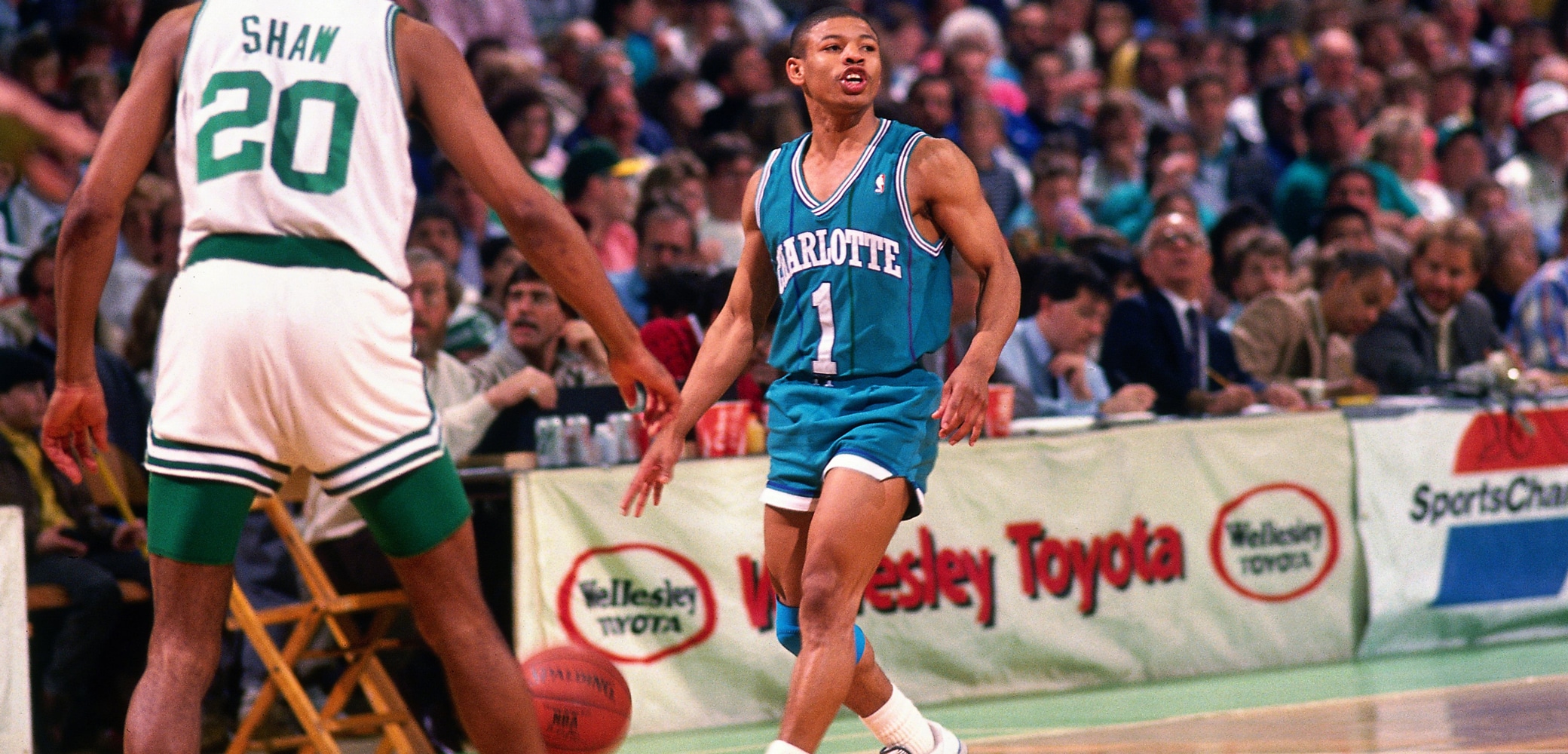
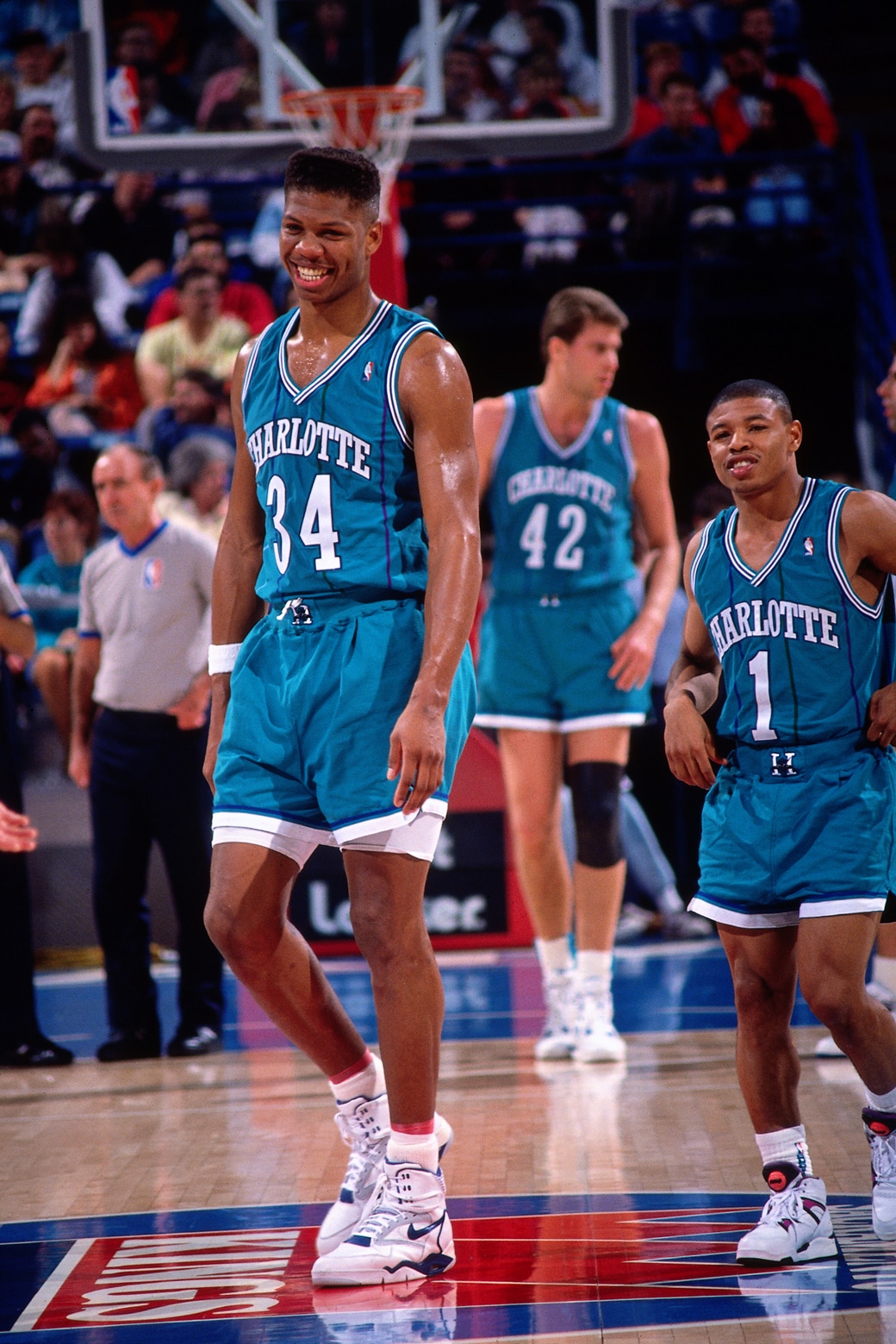
Let’s put it bluntly: No uniform in NBA history was more groundbreaking—more unprecedented—than the one unveiled by the expansion Charlotte Hornets in the summer of 1988. From the famous fashion designer to the quirky color scheme, from the pinstripes on the jersey to the pleats—yes, pleats—on the shorts, the game had never seen anything like it. Honestly, there was nothing like it in professional sports period.
Some 30 years later, the Hornets’ original uniform remains iconic, both as a time capsule of the era and as an inspiration for no fewer than a dozen teal-and/or-purple-clad expansion squads across every major pro sport over the following decade. And somehow, it still holds up. We talked to players, executives, and the designer himself to trace the uniform’s creation and its path from trendsetting new look to timeless classic.
The Origins
Alexander Julian (Men’s Clothing Designer): Hornets owner George Shinn and I shared a banker. She called me one day and said, “Would you be amenable to talking with the guy who just got the new NBA franchise in Charlotte?” I said, “Sure.” If you’re born and raised in Chapel Hill like I was and you don’t like basketball, they leave you on the edge of a town called Durham.
Tom Ward (Hornets VP of Marketing): You’ve got to remember, there were no pro teams in Charlotte. Everyone said the NBA would never work here: “This is Tar Heel country, they just care about college basketball.”
Kelly Tripucka (Hornets forward, 1988-91): People were really hesitant. This was more of a college market.
Julian: George said, “Alex, would you like to design our uniforms?” I said, “Sure.” He said, “Can I afford you?” I said, “It would be my honor, and I’ll design them for nothing, but if you sell them, I’d like my usual 5 percent.” I didn’t know how complicated the NBA system is. He said he couldn’t do it. I didn’t want to blow the deal, so I said, “George, what if I trade you ownership of these designs for five pounds of Carolina BBQ a month.” It was a way of acknowledging my contribution in a way that showed my allegiance to the state. It got covered by every newspaper in the country. My favorite headline was in the Washington Post: “Hoop Couture: Julian Designs Pro Uniforms and is Paid in Pork.” George got rich, and I got fat.
The Colors
Tripucka: We’d heard the noise about Alexander Julian getting involved. We didn’t know what that was going to be like. Maybe from our perspective, we thought it was going to be a gimmick, but I say that lovingly—that’s not our expertise. It wasn’t the way things were done in the NBA at that time.
JR Reid (Hornets forward, 1989-92): As a Carolina guy, him having ties to Chapel Hill and being an international designer made it cool.
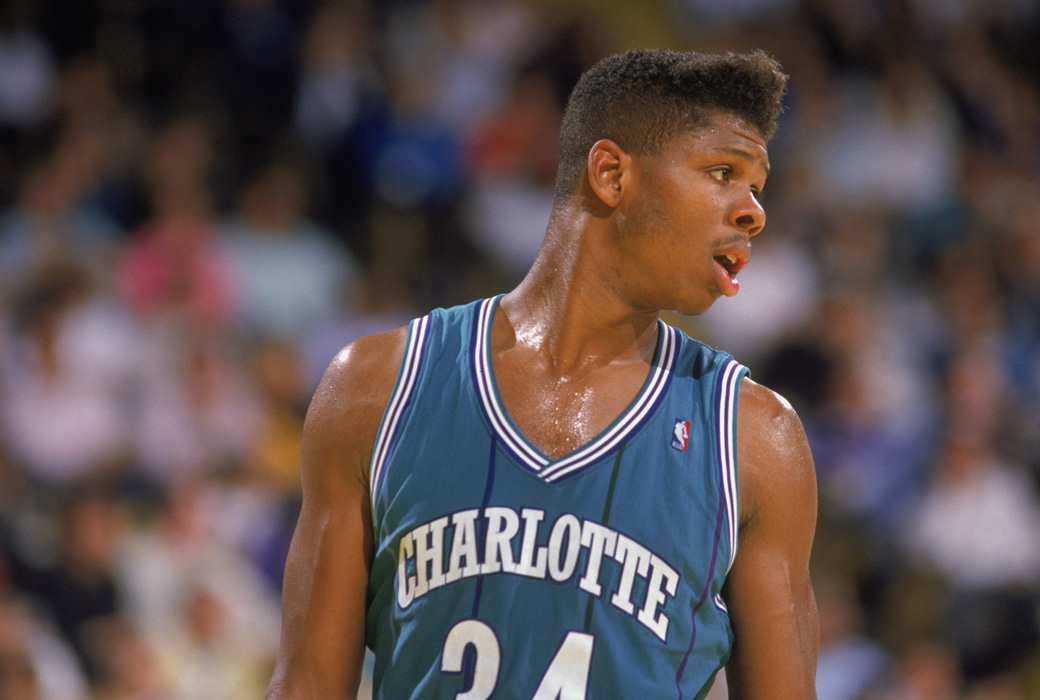
Spencer Stolpen (Hornets Team President): Up until that point, everything was Celtics green, Knicks blue—they were all hard colors. Alexander Julian basically introduced soft colors to the NBA.
Bob Scheer (Son of Carl Scheer, Hornets GM): I know my dad would have embraced it—he was the one who instituted the first-ever Slam Dunk contest and ABA All-Star Game, so he loved innovative things.
Julian: The team was going to use the colors that the architect chose for the arena: Carolina blue, white, teal. And I said, “That’s not a problem—teal and purple are my signature colors.” The problem was, what the architect and George were calling “teal” was actually a color I would call mallard, not teal. When I went to meet with him, the first thing I said was, “I can’t use this—this is not my signature color. You’ve asked me to do this for a reason. I think the uniforms should reflect the things that have made me successful.” Teal and purple were two of those things.
Tripucka: Purple and teal—I really liked them. I thought they were great colors.
Stolpen: You gotta realize, at the time, those colors were different. Alex taught me that teal was not an adjective, it was a noun; it used to be, “Is it teal blue or teal green?” He said, “No—it’s teal.” He joked that it was a noun, but we made it a proper noun.
Julian: One of my sons used to tell his schoolmates that I invented teal. They thought I got a royalty anytime anyone used it.
The Design
Julian: I wanted everything to represent the little details and design aesthetic that had popularized my brand. And I know this is difficult to believe, but I designed the first vertical striped polo shirts. That’s the reason the vertical stripes were in the jerseys, and they’re actually knitted, not printed. I didn’t want the shorts to be striped, because I wanted it to look like sportswear, so I did the stripes on just the top, not on the shorts. I added the multicolor trim, the kind of thing I was always putting on my sweaters and knits. They were the first basketball shorts—and maybe the last—to have pleats.
Stolpen: The original uniform, with the pinstripes, had six colors altogether, which totally freaked out the NBA—they didn’t know how to make the uniform. And our shorts had pleats in them. There was nothing like it. But we held our ground, and the League was able to get manufacturers that would make the product.
Ward: Thank God they didn’t get people like me involved who would have messed up the design. But when those came out, no one in the NBA had seen anything like it: the pleated shorts, the pinstripes, the colors. We just came out of left field with these uniforms, and a lot of teams emulated it.
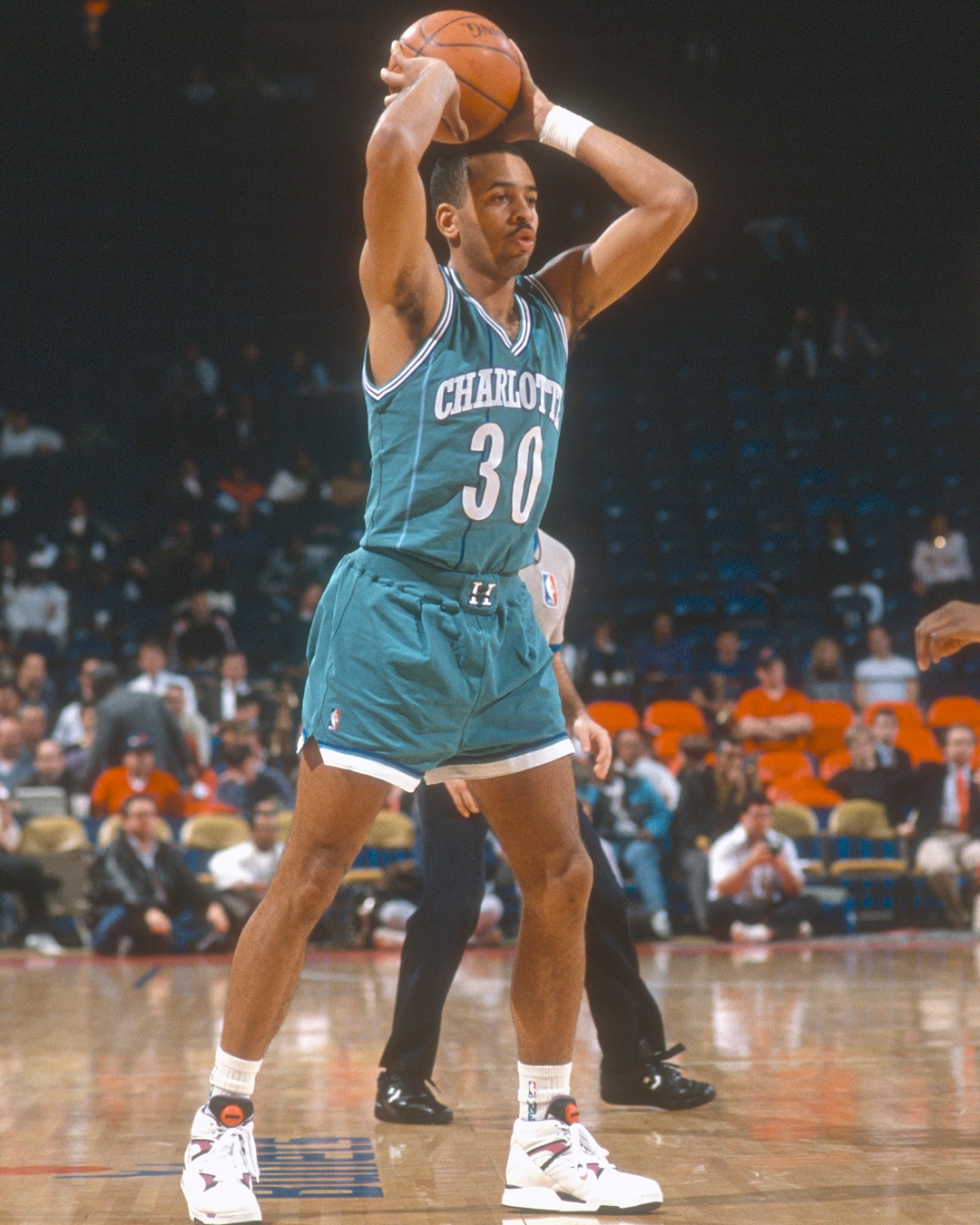
Julian: I designed it as if it was a cool sportswear outfit. Psychologically, when you put on something that makes you look good, you perform better.
Tripucka: I mean, it’s a basketball uniform—how much different could it possibly be?
The Unveiling
Scheer: There was tremendous build up to the first season, with the uniforms being a key piece. I was at the press conference where they unveiled the uniforms, with Kelly Tripucka modeling. Each announcement—coaches, players, etc.—was an event, and the uniform announcement was one of the biggest.
Tripucka: They invited me to New York, and I walked the runway like all the high-priced models [laughs]. I had no idea. My wife and I went, and it’s the first time I’m seeing them. They were different, no question about it.
Ward: I vividly remember Kelly Tripucka modeling the first ones, going on stage and snapping off those tear-away pants. When he came out, we were like, “Wow, this is different.”
Julian: Fit was important. If you’ve seen the picture of Kelly and I at the press conference (below), I keep a big version of that photograph in our family store in Chapel Hill. Kids come in, they see the shorts, they go, “Oh my God, look at how short they were!” I tell them the absolute truth: Those shorts were so radically long and baggy that Kelly and the whole team went and had them taken in and shortened before the first game.
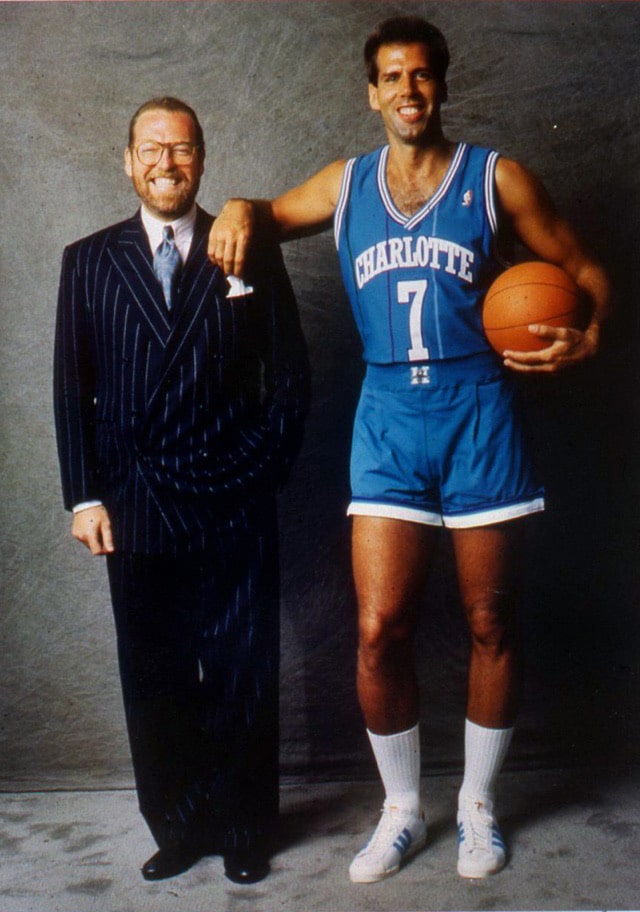
Tripucka: They had pleats, which—pleats in a basketball uniform? We had to iron them out. The way they fit, it looked like they were ballooning out. They looked silly, and way, way too long.
Muggsy Bogues (Hornets guard, 1988-97): They were different. You had some pants with some pleats in it and pinstripes. We didn’t know how they were going to be received, but they were different.
Stolpen: The fabric was a little heavier, and our jerseys were basically sleeveless shirts as opposed to tank tops. If the players had a bad night, somebody might have blamed the jerseys.
Tripucka: More than anything else, those uniforms were heavy and hot. The more you’d sweat, the heavier they got—they didn’t breathe. And then they got a little floppy. They got heavy with sweat and didn’t hold their shape. All that said, they weren’t ugly. It was a great color scheme.
Juilan: The players were all on board with it. Muggsy Bogues was terrific. Kelly was great—very easy to work with, a terrific guy. I think Dell Curry was quoted as saying it wasn’t like wearing a basketball uniform, it was like wearing a cool outfit. They felt cool—they felt dressed up. That was the idea.
The Marketing
Stolpen: When we were joining the League, we knew that the marketing was going to be more important than the product on the floor for a while.
Tripucka: We knew there were going to be a lot of losses—you hate to think that way—but at the same time they were trying to promote us, get people to come out and be enthusiastic.
Ward: This was a new franchise. All the things we did—giveaways, promotions—we tried to perpetuate the colors, the logo, the brand. We kind of threw the rule book out the window.
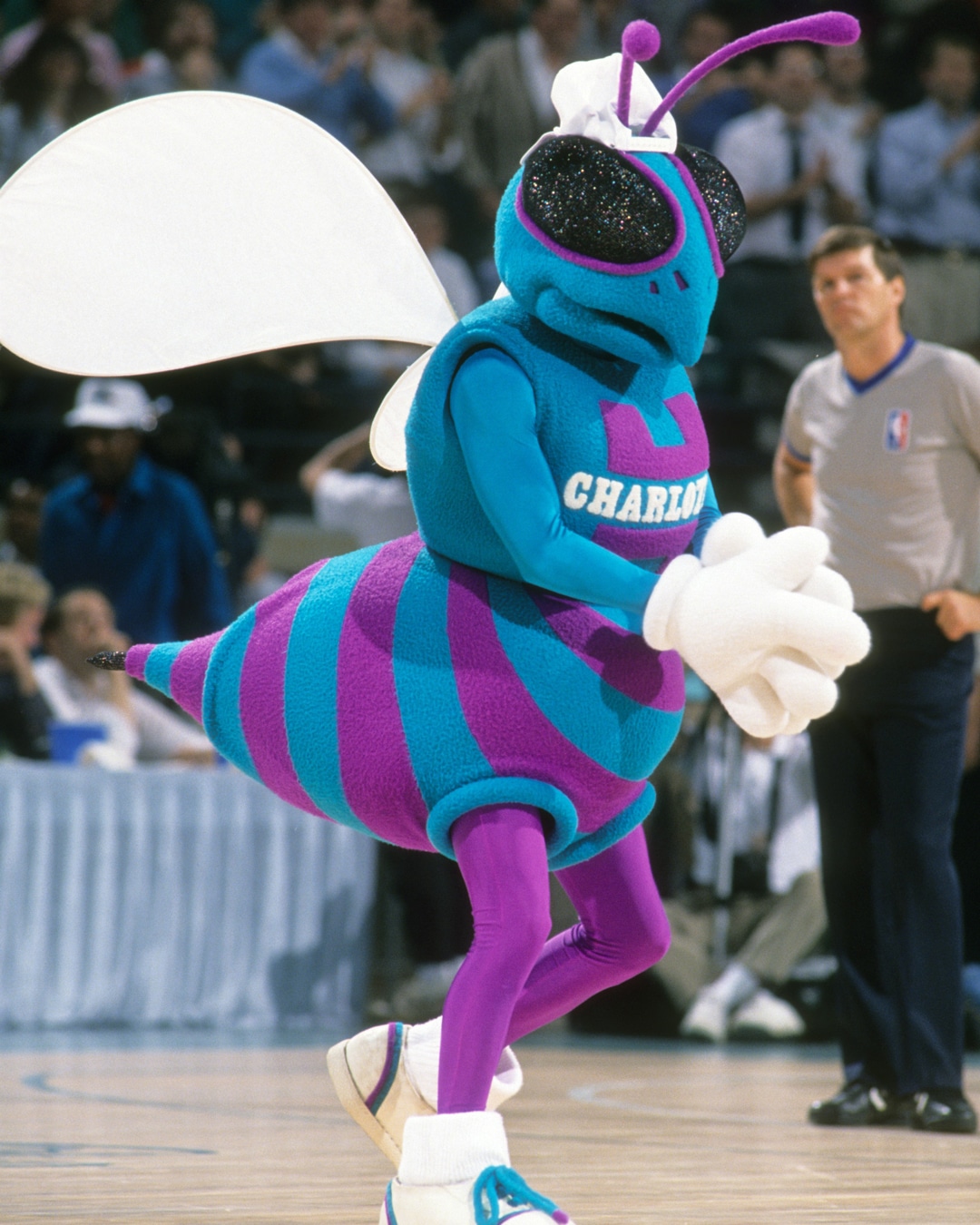
Julian: I worked with my best outside graphic designer to come up with the logo, and I used it on the shorts as if it were a belt buckle. I remember George telling me, “I want a mean bug.” That hornet on those original shorts was pretty mean.
Stolpen: Alex knew Jim Henson’s daughter, Cheryl, who designed Hugo the mascot for us. Together we put a family-friendly package together. It was kid-friendly colors, a kid-friendly mascot. You’d see little girls wearing it as well as boys, women wearing it as well as men.
The Buzz
Stolpen: It all kind of coalesced on December 23 of that first season, our first nationally televised game, against the Bulls and Michael Jordan. Kurt Rambis tipped in a missed shot to win it. Everybody saw the game. Up until then, people didn’t know who the Hornets were. They got to see our colors, they got to see the excitement.
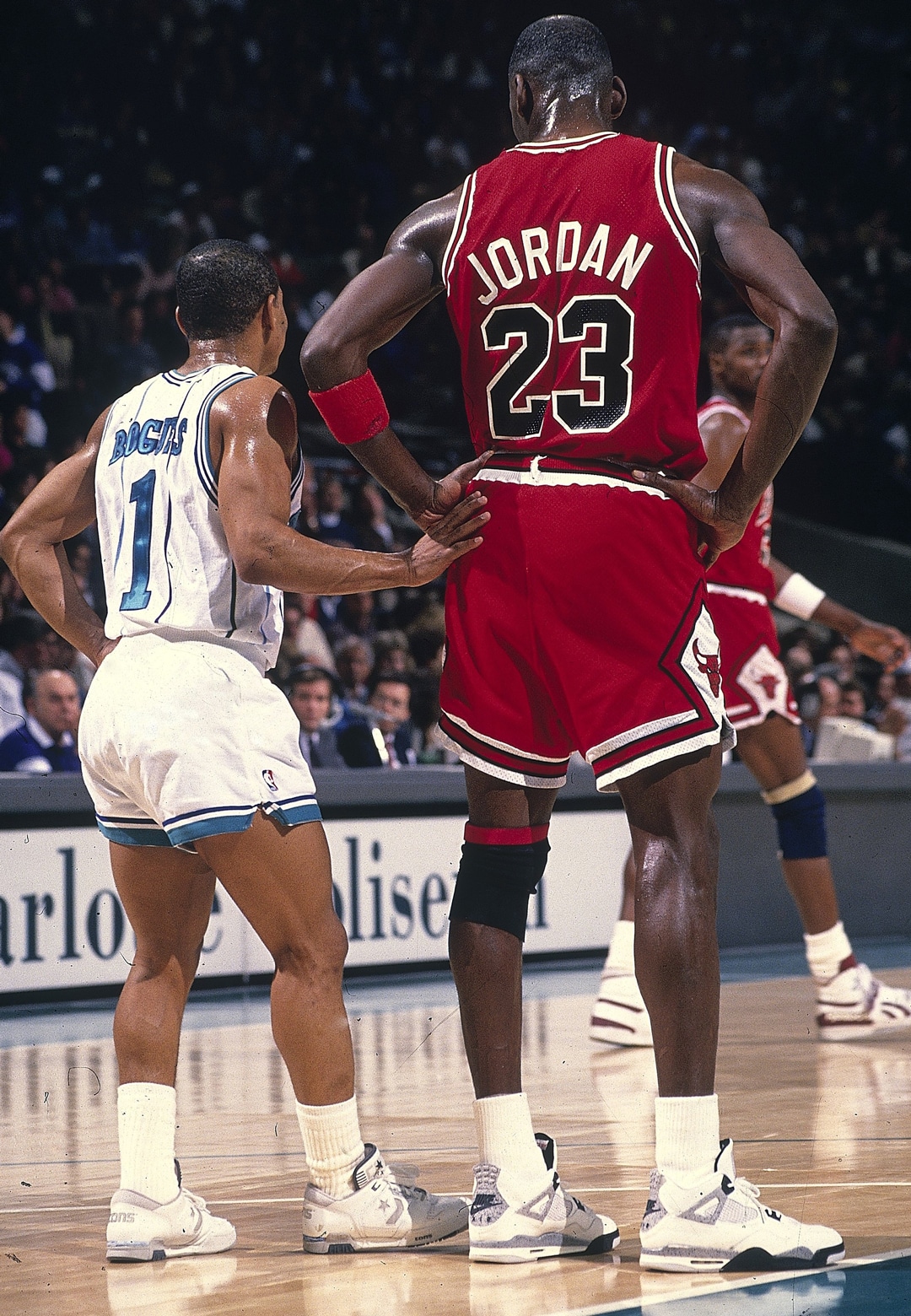
Ward: Even though we were 20-62 that first year, it still sold out. It really became Carolina’s team. We caught lighting in a bottle. People started coming out in droves every night, and that’s when all the merchandise started flying off the shelves. People just wrapped their arms around it.
Stolpen: At the end of the year, to everybody’s surprise, we were the best-selling merchandise in the NBA.
Julian: I had no idea that it would become the No. 1-selling uniform in the League. I remember George had just come back from his first trip to China. He said, “This young boy had on a Hornets hat. I got a translator to ask, ‘Do you like the Hornets?’ He said, ‘No, I like the colors.’”
Stolpen: Later in the year, we went to a Knicks game and Spike Lee was wearing a Hornets hat. Not because he was a Hornets fan—it was a style statement.
Bogues: I’ll tell you what, it became such a hot item to get because that teal and purple not only resonated in the city of Charlotte, but it resonated globally. You see people walking around with Charlotte Hornets Starter jackets over in Japan and in China. That lets you know how far it’s reached.
The Legacy
Ward: It was combination of a lot of things. The colors were very unique, very hip. And then we started to get some hip players, like Muggsy Bogues, and eventually Grandmama—Larry Johnson—and Alonzo Mourning.
Mike Spitz (Owner of Mr. Throwback, a vintage store in NYC): The iconic jerseys to me are those originals from the late ’80s and ’90s: the Hornets, the Raptors, the Grizzlies. With the Hornets, the coloring is dope, and of course those pinstripes. As a basketball guy, you remember Grandmama in the Hornets jersey, Muggsy, Alonzo Mourning, Anthony Mason. In a lot of ways, when you remember these players, you’re really remembering the jersey. As a collector, I really relate to them.

Reid: The jerseys were awesome. Being a part of the Hornets in that teal jersey that took the country by storm was a tremendous honor.
Julian: My standard quote is, “Imitation is the sincerest form of admiration.” In my business, if you don’t get copied, you’re no good. But I am incredibly proud that they have stood the test of time. And the greatest benefit that came out of it: One of my childhood heroes, Dean Smith, called me because of the success of the Hornets uniforms and asked me to re-do the Tar Heel uniforms. Now my argyle is on every sport for UNC.
Bogues: Alexander Julian did an excellent job when he designed those uniforms. There’s never been anything close to it. That’s how you separate yourself—being unique, being different. And at that time, we were all that. And he was able to create a special uniform that we’re still talking about after 30 years.
Ward: The thing that was different from a lot of other teams, we had these uniforms from the beginning. This wasn’t an evolution. I think that’s why they have staying power. They’ve always been part of the history of the Hornets.
Tripucka: Now, it’s kind of iconic. When they announced the name change back to the Hornets a couple of years ago, I said to Michael, “This is gonna be the smartest thing you ever did.” I happened to be in town when they made the announcement, and you had hundreds of people standing outside the arena all wearing their old Hornets stuff. People were just raised on that. They wanted that back.
Julian: We never got any championships. But we sold a shitload of uniforms.
—
BUY YOUR COPY OF SLAM 220 FEATURING KEMBA WALKER.
Ryan Jones is a Contributing Editor at SLAM. Follow him on Twitter at @thefarmerjones.
Photos via Getty.