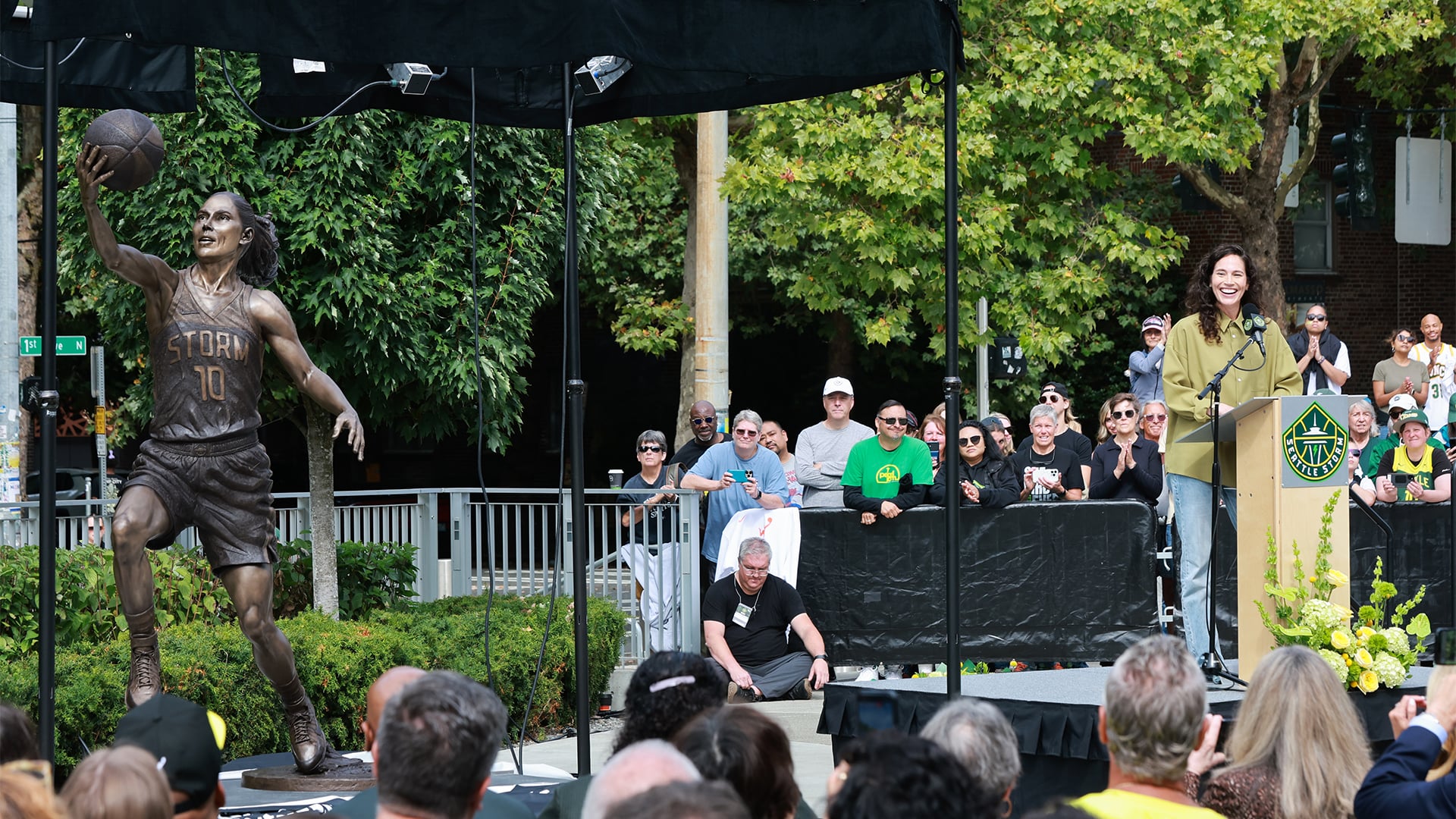
World Stage: Lauren Jackson, Icon of Seattle and Australia
A ballplayer so grand that one single town couldn’t hold her. One single city couldn’t hold her. One single country couldn’t hold her. One single continent couldn’t hold her.
If all the world’s a court, Lauren Jackson isn’t merely a player.
She’s the player.
LJ is a native of Albury, New South Wales, Australia. That’s where the first steps of her epic basketball odyssey originated. From that small town on the west coast of the Premier State, LJ’s journey took her all around the world, all the way to Russia, even. She also had stops in South Korea, China and Spain, accented by games all over ‘Straya for decades.
The full story of LJ, the highs and the lows, and all the championships, can’t be told here. It’s simply too long, for she made the most of this wide and universal court and that story deserves much more time, thought and detail. LJ has proven, without a shadow of a doubt, that her skill on the court is otherworldly. A dominance entirely unique and foundational belongs to her. With her endless range as a 6-5 forward, she is now the bedrock that the modern game continues to build on, always there, never to be replaced no matter how many layers are added. Plus, she owns the distinction of winning championships on multiple continents. And she made it all look easy, even when it wasn’t.
Instead of the whole story, we’ll focus on LJ’s time in Seattle. As a member of the Storm, LJ became a two-time WNBA champion and a worldwide representative of not only her home country, but also the Emerald City. She’s synonymous with Seattle basketball. Her updated status as a WSLAM ICON should come as no surprise. We chatted with the Hall of Famer for a brief discussion in celebration of the newest line item on her impossibly long list of accomplishments.

SLAM: I’d love to start with these four words that I heard you say one time which are: dream, believe, create and succeed. I would love to know how those four words came to you?
Lauren Jackson: When I was a kid, one of the Australian Ironmen, I think, had said that. It was in the 90s. And I think I just latched onto it. I made a little poster and put it up in my room because it resonated. That word “belief,” as well. Maybe I didn’t think so much about it then, but as a kid, it’s so important to dream and believe. And they’re obviously foundational to creating and succeeding. So it just made sense.
SLAM: Do you still have that poster?
LJ: No, I don’t, but I think whenever anyone asks me about words of wisdom, I tend to throw them out because, yeah, they definitely stuck with me over the years.
SLAM: It’s fair to say that you’re a dreamer. Accomplishing the goals that you have accomplished requires dreaming and believing. Between the ages of 4, when you first picked up a basketball, and 14 or 15, when you made the Opals, when did it start to sink in, this belief, this dreaming that maybe you’re going to be different than every other kid at Murray High School because you had this insane passion that was inherent only to you?
LJ: Growing up in the 80s and the 90s, there wasn’t a lot of basketball on TV, particularly women’s basketball. But I did follow the NBA quite closely, and I said to my parents, I want to be the first woman to play in the NBA, not realizing that there had been women who played in the NBA before that point. [editor’s note: look up Denise Long and Lusia Harris]
But, having the parents that I had, no one ever said to me, that won’t happen. They just enabled me to believe in what I could achieve. By the time I went to Murray High School in year seven, I was telling people that by year 10, I’d be out of there, that I’d be at the AIS. I just knew in my heart that I was going to be a basketball player. I wanted to be like my mom, who played for Australia and represented Australia. That was the path and I didn’t waver. When I’ve got my mind set on something, I generally work toward it, consciously or unconsciously.


SLAM: And speaking of your mom, she made history by playing at LSU, and your pops played, too. You were exposed to basketball at a young age, which is no guarantee that it will become a life-long passion. Was there some type of aspect of the game that you got addicted to when you were young, even while you were playing netball and tennis?
LJ: No, I just always loved the sport. I think too, being such a tall kid and it was a sport that I loved, it was really the only place where I felt home, because of my height, and I was just a very awkward kid. So, when I was out on the court, it was my playground. It was where I felt completely safe and happy and I was very competitive as a kid. To a fault. You learn a lot of lessons as a child as well, in sport, but I think that creates resilience. But yeah, I always just thought that this was the path that I would be on.
SLAM: It seems like in almost every interview that I’ve read and seen of yours, at some point along the way, a phrase along the lines of “the journey is the dream” comes up. It’s a phrase that makes me think of all those Tuesday mornings after the big weekend games where all you want to do is rest, yet you still go to the gym. How did that wisdom find its way to you?
LJ: I don’t know if it really found its way to me young. It definitely came later on in the piece. I never knew anything other than basketball or training for basketball. I think from the age of 15 we were up doing 5 a.m., 6 a.m. weight sessions and basketball sessions. It just was what I did and I don’t think I knew any other way. So, when I retired the first time, and had the injuries, I think that’s when you sort of reflect on everything, because life changes. You have kids, you get a job, you’ve got different priorities. And, for me, those priorities have been the most important thing in my world. But when I did get back to play basketball again after that, I learned to appreciate that journey much more. And I put a lot more into the stuff off-court and the training off-court than what I ever did before. That definitely helped me. But it happened a lot later and I think I grew up very late in life. As a young person, in the WNBA, I wish I knew what I know now for sure.
SLAM: You’ve spoken about how there was some trepidation about moving from Albury to Seattle as a young person. It was the great unknown for you. But you did it and you spent a whole lot of time in Seattle. What are the similarities between Albury and Seattle that, even in the face of that anxiety, eventually made Seattle feel so safe for you?
LJ: Oh, well, Seattle became my home. I love Seattle very much. And I didn’t know what to expect. I was very young and I was a country kid from Australia. The biggest city that I’d ever really lived in was Canberra, which is just a big old country town in Australia. So I didn’t really know what I was getting myself into. But I think in the first couple of years, I really settled into Seattle and I think it was the music. I absolutely loved the music scene, the grunge. I think the waterways. I love the water. I spent a lot of time at the water growing up, obviously the ocean. I would say the people. I think the fans, they really embraced me. But I think the basketball culture too, with the SuperSonics there, it was awesome. The training facility we had. It was a beautiful, beautiful place. Seattle was definitely one of my, well, it was my home.

SLAM: What music reminds you of Seattle these days?
LJ: Oh gosh. I went to so many concerts. They used to have, oh, I can’t remember what it was called, but concerts down at the pier during the summer. So we’d go down to the pier, at Puget Sound, and gee, it was beautiful. But I remember seeing Macy Gray down there. I actually met Melissa Etheridge once, which was very, very cool. But a lot of Australian bands rolled through there too. Paul Kelly, The Waifs. Oh, gosh, who else..? A lot of Australian bands, yeah, went through Bumbershoot. So that festival and that sort of vibe was very much what I was into. It was very cool.
SLAM: While we’re on Seattle, what would be three words to describe your 2004 championship and what would be three words to describe your 2010 championship?
LJ: That’s a very good… they’re very good questions. Three words? Well, 2004, I would say fun. It was, what else? I can’t even think. Gosh, that’s a really good question… I think in 2010, it was a long time coming. So I would say that. That was a long time coming. Because of injuries and other things that we’d gone through, I think people thought we would’ve probably got a few more championships in between that. But, the first one was just exciting, it was fun and I don’t think any of us expected that it would happen that early, at that point. They were really hard to come by, those championships, but gee, they were awesome. And we worked so hard for them.


SLAM: Which one of your Seattle teammates would make you laugh the most on the road?
LJ: Would make me laugh the most on the road? Probably Sue [Bird]. She always made me laugh. She’s funny. You know, she’s very articulate, and yeah, she’s got some good one-liners.
SLAM: And speaking of teammates, you had the privilege of playing with a lot of the same teammates on a lot of different continents for many, many years. When you think about the soundless, worldless connection and trust required to excel at the level that you did, is there a teammate whose kinship was the most cosmic? A relationship that would only require eye contact? Whether it be Australia, whether it be Seattle, even Russia?
LJ: Yeah, I would say it got to that point with Sue and I, for sure. With Australia, for many, many years, I grew up playing alongside Penny Taylor here in Australia. So I would say with the Opals team, it got to the point we were definitely on the same wavelength for many years. And then who else? Yeah, I’ve had some great teammates that I’ve had great chemistry with on the court. I like Tess Madgen even more so recently with the Opals. When there was trepidation on my part, she was the sort of person that you would look at, and I’d be like, no, it’s okay. It’s okay to feel this way. Like, my teammate’s got my back. So I think she’s another one. But yeah, I would say probably Sue.

SLAM: Speaking of the Opals, how did you guys celebrate in ’06 after you won the World Championship? Did you take the trophy back to Indian Tandoori on Dean Street in Albury?
LJ: No [laughs]. I think at that point in time, I was living in Sydney. I had an apartment in Sydney. But we only really went out in Brazil that night. We were talking about this yesterday actually, but we didn’t really spend that much time celebrating it. We had that one night in Brazil and then everyone sort of went their different ways. We had people playing in Europe and all over the globe. So only half of us ended up coming back to Australia. And yeah, I do know a few of us got sick from the flight home, but yeah, no, we didn’t really get to celebrate it that hard.
SLAM: Lastly for you, LJ, you’ve been very open about all the different emotionally overwhelming moments that you’ve had recently about, just reflecting about basketball. It’s really difficult for most people to understand that when you dedicate so much time and you sacrifice your body and you lose time with your family, that the game can take on a different meaning. We know you’re still active–you just had a 50-ball two years ago. But as you reflect, on all the things you’ve done on the court and missed off the court, where does the game reside in your heart these days?
LJ: I’m just… I think gratitude. Everything that I do now in the game, particularly in Australia, is trying to elevate it and promote it, because what it gave me, as an athlete and as a person… And like I said before, it’s something that I probably didn’t think too much about when I was in it, but it’s not until you’re past it and you have time to reflect on it. I’m so grateful for basketball. I truly believe in the power of it, in connecting people, in changing lives, and sport in general. I think it’s so important for kids to get involved in it and stay involved. And particularly now with AI, you know, there’s nothing like going and watching live sport and being a part of those moments that cannot be recreated. They are real. So, for me, yeah, it’s gratitude, it’s trying to elevate it and put it where it belongs. I love the sport and I’ll continue working in it and trying to get more and more girls playing it, because it’s, yeah, it’s amazing.