Cade Cunningham’s MVP Case Is Real, Even If He’s Not Winning It Yet
Despite being a top-five NBA Most Valuable Player candidate this season, it’s still fair to suggest that Cade Cunningham isn’t getting as much credit as he deserves.
Now, this isn’t to say Cunningham should be the MVP this season. Historically speaking, when it comes to this award, it usually takes one season of being in the conversation before a player truly gets a seat at the table. From there, winning the award can happen in the following seasons. Rarely does someone burst onto the scene as an unexpected MVP candidate and actually win it that first breakout year. There is a narrative component to the award, a kind of initiation period. You have to be perceived as an MVP-level player for more than one season before the league fully buys in.
That’s not a hard and fast rule, but it’s what history consistently tells us.
At this point, Shai Gilgeous-Alexander is the clear front-runner for the award and would be on track to go back-to-back. Nikola Jokic, if he’s able to reach the 65-game threshold, which is still to be determined based on his injury timeline, belongs in that same tier as Gilgeous-Alexander. Luka Dončić sits in the tier just below them, a real contender, but not quite at the same level this season.
And Cunningham is in that same tier as Dončić.
That alone is a massive accomplishment. Cunningham is clearly getting respect from peers around the league, the media and fans, something that’s reflected in his NBA All-Star starter nod. But the level of respect still doesn’t quite match the reality of what he’s doing on the court. And again, a lot of that comes back to timing. A player usually has to be perceived as an MVP-caliber force for a full season before being taken seriously in the race.
But if blind resumes were all that mattered, there’s a world where Cunningham has a case to be placed in that very top tier this season, not behind Jokic and Gilgeous-Alexander, but right alongside them.
Remove the names. Remove the teams. Just look at the resume. Cunningham has as compelling of an MVP case as almost anyone in the league.
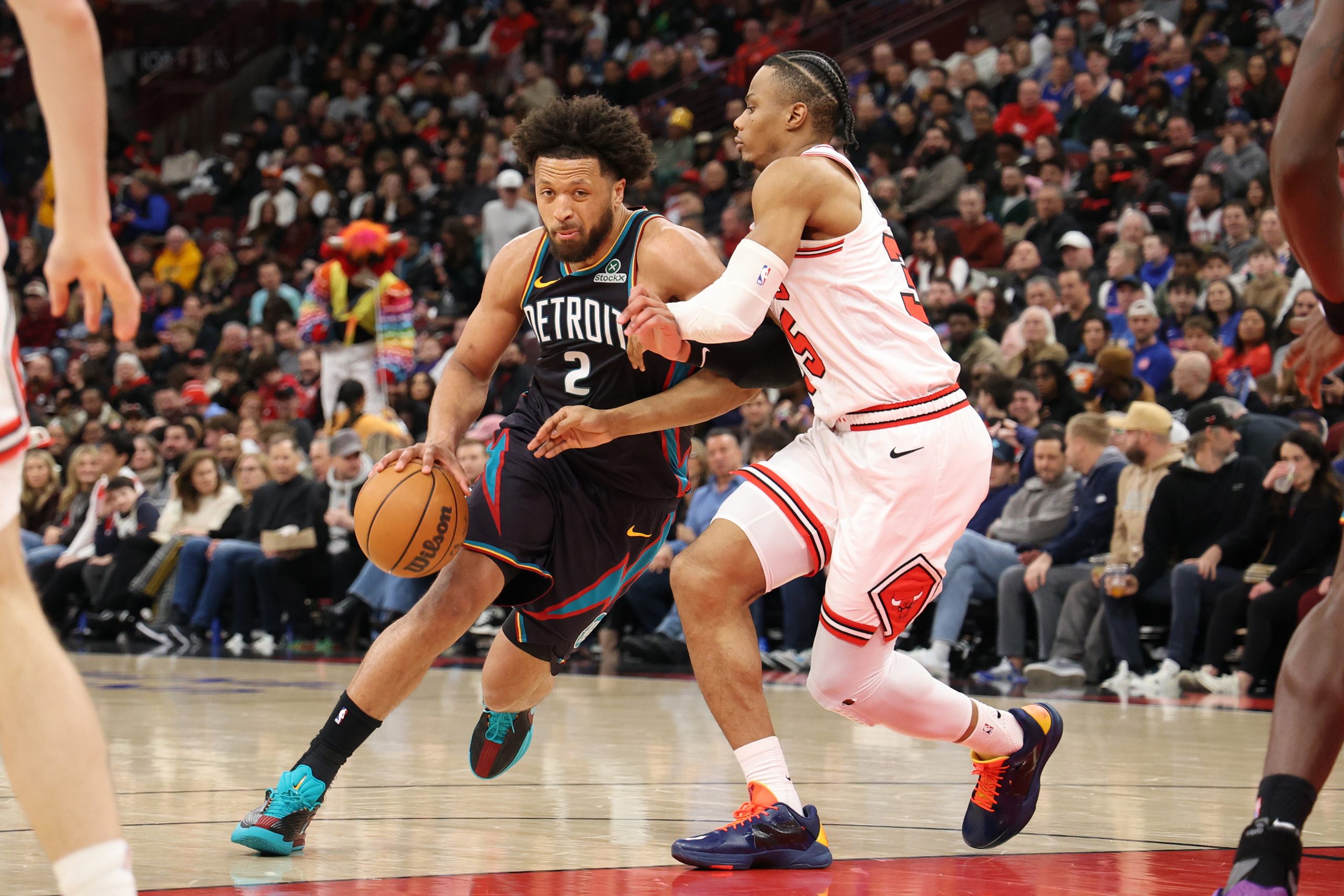
Start with the raw production. Cunningham is averaging north of 25 points per game, nearly 10 assists, and almost six rebounds per contest. He’s also giving you around one and a half steals and nearly a block per game. His on-court plus-minus and advanced impact numbers tell a similarly strong story. This is elite two-way production from a primary ball handler who carries one of the heaviest offensive loads in the NBA.
And he’s doing it against defenses that are specifically designed to stop him every single night.
This isn’t secondary star production. This isn’t the best player on a bad team production. This is true offensive engine production, the kind of profile you see from players who completely drive their team’s identity. The Pistons’ offense is built around Cunningham’s decision-making. He initiates nearly everything. He scores at all three levels. He creates easy looks for teammates. And he does it while maintaining strong efficiency despite the defensive attention he draws.
That’s exactly what MVP seasons look like.
Now add the team context, which is where this argument gets really interesting. The Detroit Pistons are first in the Eastern Conference and entering the NBA All-Star Break, they have the best win percentage in the NBA. After recently surpassing the Oklahoma City Thunder in that regard, the case for Cunningham has never been stronger.
Historically, MVP voting is driven by two things above all else: elite individual production and team success. Cunningham has both. If a blind resume showed a player leading his team to the first or second-best record in the league while putting up these numbers, it would be almost impossible to argue against how strong that case is.
And there’s no 1A, 1B dynamic here. This isn’t Boston, where Jayson Tatum and Jaylen Brown share the spotlight. This isn’t the Lakers, where Dončić and LeBron James can feed off each other. This is Cunningham as the clear alpha, the undisputed face of a very good, well-constructed team. The Pistons aren’t a weak roster that Cunningham is dragging along, but Cunningham is very clearly the engine that makes everything go.
When Detroit wins, it’s because Cunningham is great. So why isn’t Cunningham being treated like a true MVP front-runner?
Again, a significant part of it is that probation period. The league still needs time to fully adjust to Cunningham being in this tier. Everyone goes through this. Gilgeous-Alexander finished top five in MVP voting multiple times before finally winning it. Jokic had to prove he was at that level for a year or two before starting to collect trophies. The same is true for Giannis Antetokounmpo before that. That’s just how the award tends to work.
There’s also the market factor.
Detroit doesn’t get the same national coverage as teams like the Lakers, Celtics, or Warriors. Cunningham isn’t living on national TV. Cunningham isn’t leading highlight shows every night. Cunningham is doing MVP-level things in a market that doesn’t naturally amplify him. The Pistons are a historic franchise, but they don’t command the same cultural attention as the league’s biggest brands.
And fair or not, there’s still an Eastern Conference tax. The West is generally perceived as deeper and more competitive, so stars in that conference often get more automatic respect.
But if you ran a true blind resume test, no names, no teams, just numbers and results, Cunningham would look exactly like an MVP front-runner. Best player on a top seed. A system built entirely around him. Elite production, elite impact, elite winning.
That’s a legitimate MVP profile. Even if it wouldn’t be the best resume in this particular season, it’s MVP-caliber and might be a leading case in some seasons of the past.
So this doesn’t mean Cunningham should win the award this season. Gilgeous-Alexander still has the best overall case. Jokic, if he returns in time, still has a stronger resume to this point in the season. But Cunningham deserves far more consideration than the current discourse suggests.
The production is already there. The impact is already there. The team’s success is already there. The narrative and conversation just haven’t fully caught up yet.