Eye of the Storm: SLAM 39 Feature on Knicks Sharpshooter Allan Houston
This story, written by Ben Osborne, originally appeared in SLAM 39, from January of 2000. Shop the whole Knicks x SLAM collection here.
The screams are ear-splitting. Loud, high-pitched cries driving me to distraction. Allan Houston is unfazed, however. I’d seen him calm, cool and collected on the court, where the New York Knick guard has stuck game-winning jumpers, bounced in leaners and wetted countless free throws in front of riotous crowds at Madison Square Garden. But could he possibly be so serene off the court?
The outbursts are coming from the mouth of Houston’s first child, a beautiful daughter named Remie who was born on June 12th, just hours after Allan played one of the most remarkable games in Knick history. On the insane night of the 11th, Houston had led a Knick team sans Patrick Ewing and Larry Johnson (for all but the first 14 minutes of the game) to an Eastern Conference-clinching victory over the Pacers, scoring 32 precious points while simultaneously exposing Reggie Miller as a fraud by holding the Pacers “leader” to just 8 points on 18 shots.
But my, how Remie has grown up since the day after her father saved the Knicks’ season (for the second time). Arriving at the stunning Connecticut mansion Houston inhabits with Remie and his wife, Tamara, who is out for the day, I’m told to wait a moment while he calms down his daughter. She’s not as easy to silence as Reggie, however. Allan probably would have conducted the interview right away anyway, so calm was he in the storm of his tired three-month-old, but I’m shook. So I wait, admiring the Houstons’ gorgeous backyard, comfortable furniture and striking African art. Besides a few videotapes with Knick logos, I see no evidence that this is the home of an NBA player.
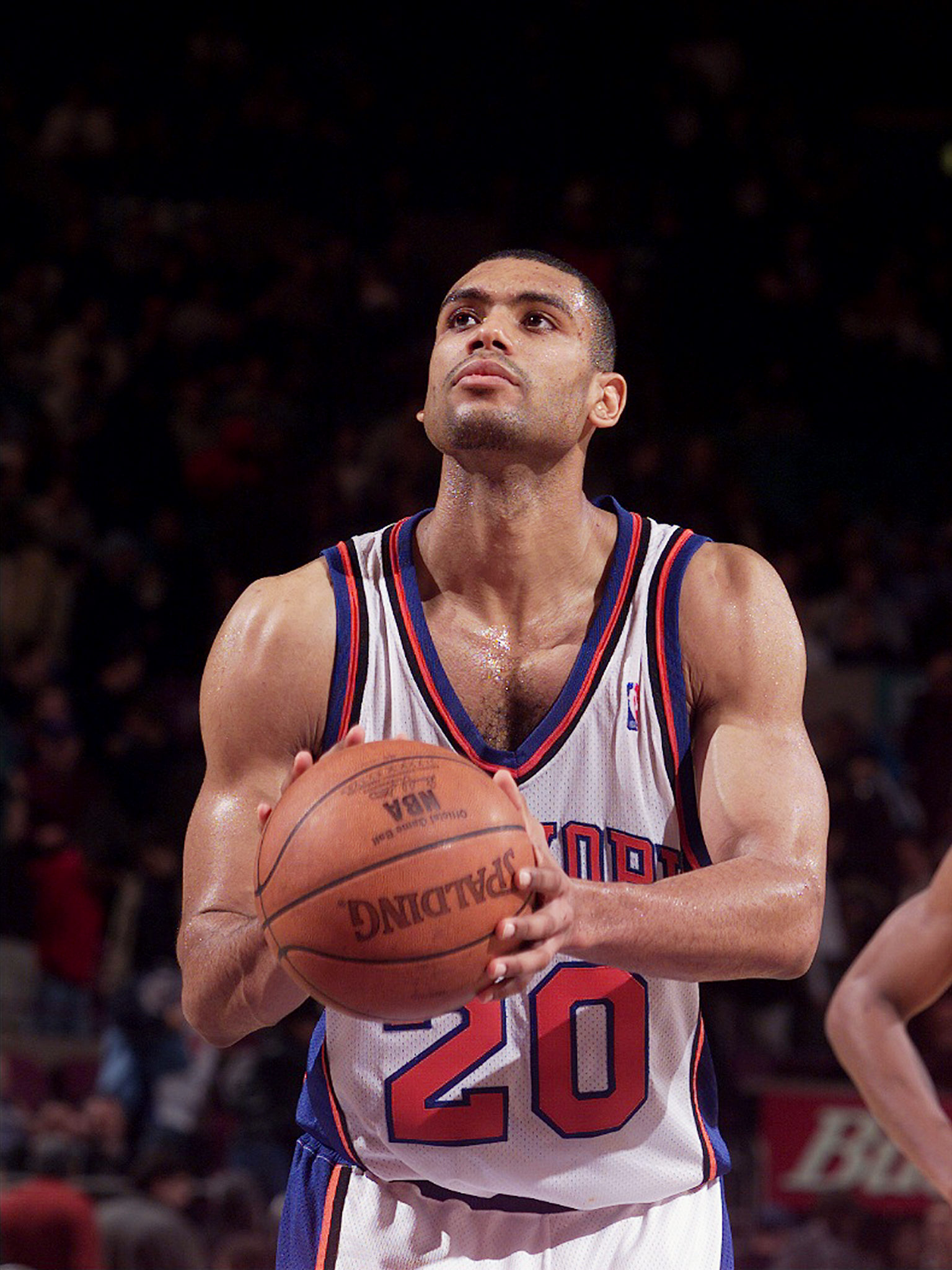
When Remie finally falls asleep, a good half-hour after the interview was supposed to have concluded, I expect a Q&A wrought with clichés and disinterest from my exhausted subject. But Houston is—again, much as he appears on-court—thoughtful, patient and quietly confident. He expresses his belief that he is the NBA’s finest 2-guard.
“I look at it like I am the best,” Houston says. “Not trying to disrespect anyone else’s game, ’cause there’s a lot of guys that can play, but is there a Michael Jordan out there who’s obviously better than everyone else? Not at 2-guard.”
It’s a surreal way to hear such a pronouncement. I mean, where’s the posse backing up Houston’s words? The PR staff? The dozens of disheveled beat writers? Here I am, sitting in the guy’s living room, moments after he plays Mr. Mom with his young daughter, and he’s telling me he’s the best 2-guard in the NBA?!
Get past the uniqueness of Houston’s personality and lifestyle, however, and think about the question at hand—is he the best? Yes sir. Who would you rather have? Mitch Richmond is over. Steve Smith has no knees. Penny whines. Isaiah Rider is missing. Iverson is a one and a half. Kobe’s a two and a half. And Reg, well, Reg caught the answer in the playoffs last season, and it was a definitive one—at 28 years old, the 6-6, 200-pound Houston has arrived, and he’s at a place that all the has-beens have left for good.
Houston’s lockout-season digits—16.3 ppg, 3.0 rpg, 2.7 apg—actually were not much better than the 15.3, 2.8, 2.3 averages he’s posted over the whole of his six-year, Detroit-NYK career. But not only did Houston up his output considerably in the ’99 Playoffs, he also scored high on the far-more-important test for greatness by helping, hell, making his team win. Before willing the wounded Knicks to victory in the Pacer series, Houston hit the shot that made it all possible, an unlikely runner with less than a second remaining in Game 5 of the Knicks’ first-round series that sent Pat Riley and his limited soldiers to an early vacation. Despite the shot’s—and the season’s—uncertainty, Houston was calm.
“Everything that was surrounding it [Remie’s birth] really took a lot of pressure off of me, because it put everything in perspective,” Houston explains. “Being in the playoffs, in New York, a lot of people would get affected by all the excitement. But by the Finals [during which Houston averaged 21.6 ppg] I was having the best time of my life, on and off the court.”
As simple as Houston makes it sound, the idea of him and Latrell Sprewell serving as the Knicks’ post-season saviors would have been a hard one to imagine for both the cynical collection of media members that chronicle the Knicks’ daily life and the team’s manic-depressive fan base. The Houston who had toiled for the Knicks since he signed a fat free-agent deal with New York in the summer of ’96 had typically been viewed as too soft, too boring, even scared. The general opinion was best expressed by lan O’Connor, then of the New York Daily News. “Houston is a pleasant soul. Respectful. Polite,” wrote O’Connor in the middle of Houston’s first season in NYC. “But in New York, that can be a problem. The city likes its athletes nasty. A few wayward jumpers, and suddenly he is [another] big-money player who, according to perception, doesn’t want it enough.”
Maybe Houston looked tame compared to the man he replaced as the Knicks’ starting shooting guard, the fiery John Starks, but Houston’s jump shot was plenty “nasty.” Furthermore, the fact that Houston wasn’t dropping 20 a night like he had his last season in Motown had a lot to do with his new teammates. “We always had so many things going on,” Houston recalls. “Is Patrick healthy? Who’s starting where? In Detroit, my role had been more defined, but here I had lost my identity. [After last year’s playoffs] I think I’ve established myself.”
Knicks’ coach Jeff Van Gundy, the man who ran nearly every play through Patrick Ewing whenever the big fella was out there—helping knock almost three shot attempts per game off Houston’s stat sheet between the ’95-96 and ’96-97 seasons—also noticed a change in Houston’s play last spring.
“He has a hunger to score now that he didn’t have before,” JVG said during the Finals. “I thought for the first year and a half that he was here, he was very content if he got 20 points. If he got 20, he was content to stay at 20. Now he has a continuing hunger to keep scoring.”
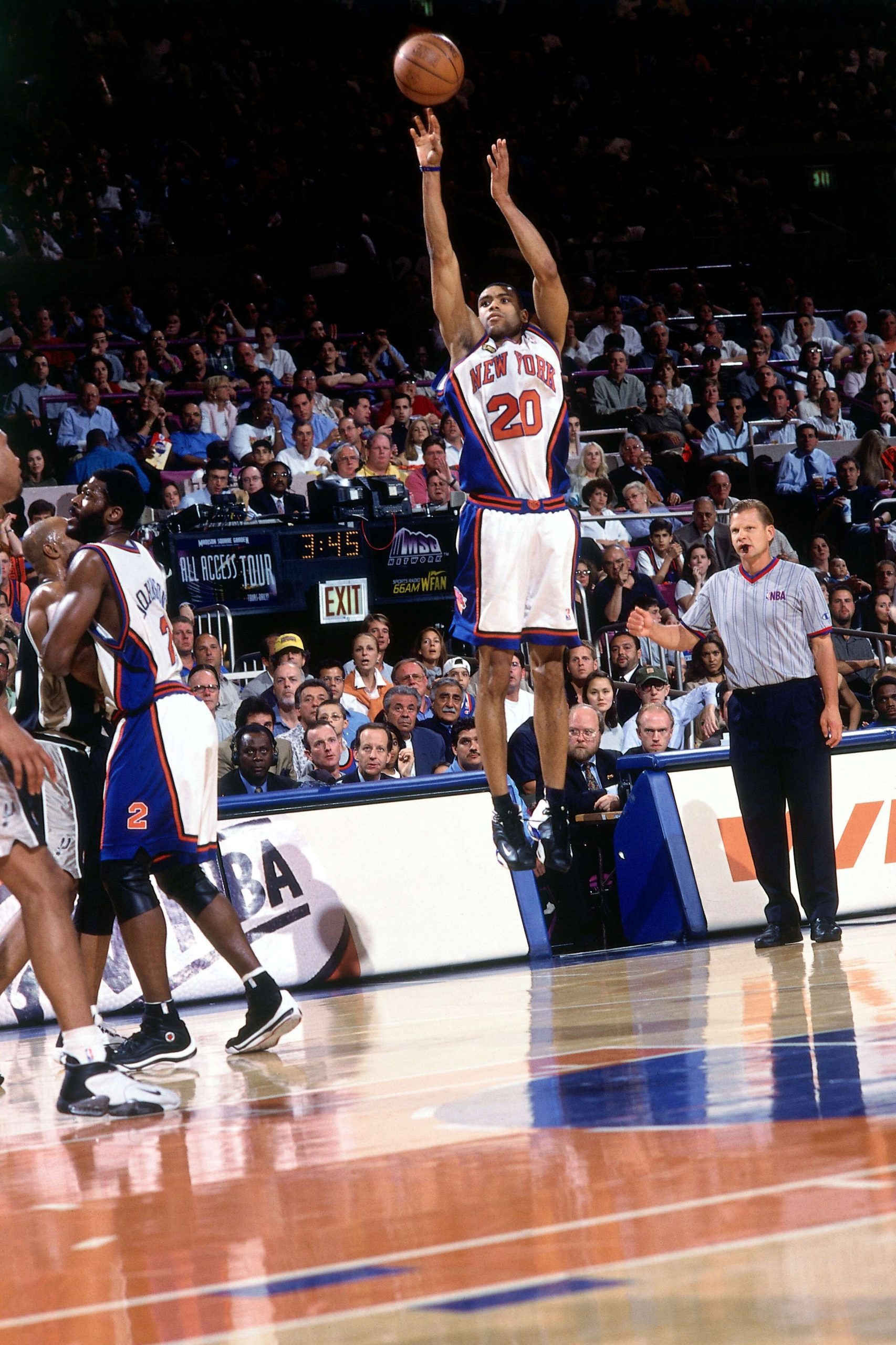
The people who blamed Houston for his unspectacular start with the Knicks franchise never looked at his background. Had they done a little research, they’d have learned that playing professional basketball—even in big, bad NYC—was not a concept that was going to “scare” Allan Houston. “I played high school basketball in Louisville, Kentucky,” Houston states. “At 15 years old, I was playing in front of 23,000 people at Rupp Arena. That’s how big high school basketball in Kentucky is.”
Houston’s career at Ballard High earned him more honors than Benoit Benjamin has had teams. There was a state runner-up as a soph, a state championship as a junior, and as a senior being named Kentucky’s “Mr. Basketball” and a first-team All American by anyone who announces such teams. Houston was also the third leading scorer in that year’s McDonald’s Game.
And Allan wasn’t even the person who made big-time hoops a way of life for the Houston family. Allan’s father Wade had been a successful high school coach in Louisville since before Allan was born, and in ’76 Wade took a job at the University of Louisville. “Playing for Louisville became my dream,” Allan says with a smile, the slightest of Southern accents detectable in his smooth voice. “Not the Knicks, not the Bulls. The University of Louisville. You can’t imagine a more intense college basketball community, and I was living it. I got to go to the Final Fours, meet Pervis Ellison, Milt Wagner. When I got to high school, my friend and I almost got in a fight over who would wear number 20, because that was Milt Wagner’s number. I got it.”
Houston had not only an understanding of basketball hysteria but also some serious dexterity. “As a youngster, Allan’s skills were obvious,” remembers Wade Houston. “He was a good athlete and he possessed great hand-eye coordination, What I worried about was his size. He could shoot, pass, dribble, do all the right things, but I knew how much bumping and grinding there was in college.”
Allan had similar concerns.
“As a high school freshman, I went about 6-2, 147,” he says with a chuckle. “I started preseason with the JV team, and I was mostly on the wing or at the 4, which is what happens when you’re 6-2 at that age. But when the coach saw how I played, he said, ‘Well, you can shoot it and dribble it. I’m putting you at guard.’ It was a bold thing for him to do, being that I was a freshman and taller than a traditional guard, but he did it, and I was the starting varsity 2- guard from then on.”
Houston instantly received an obscene amount of attention, and by all accounts he handled it flawlessly. The excitement peaked in the fall of Houston’s senior year when he signed a letter of intent to play at the University of Louisville, where his father had become the legendary Denny Crum’s right-hand man. The thrill lasted a few months—until the following spring, when the Houstons got an important phone call. “My dad had gotten the head coaching job at Tennessee,” Allan remembers. I was so happy for him, but all of a sudden it was like, wait a minute, what am I going to do?”
It didn’t take long for the younger Houston to realize that family came first, and he asked Louisville to release him from his commitment. “I don’t need to go blowing up the situation, but it wasn’t the easiest transition on their part,” he says about Louisville’s handling of his transfer. Eventually the NCAA stepped in with a rare show of common sense, and Houston was allowed to proceed to Tennessee without punishment, a fair enough move considering all that Wade had done for the ’Ville. UT suddenly had a chance to bring back its glory days of the ’70s, when Bernard King and Ernie Grunfeld led the Vols to some of their most successful seasons ever, but even the Houston clan couldn’t save a program that had mostly struggled since Bernie and Ernie left.
“We had a hard time in that conference, which had many great players like Spree, Chris Jackson, Jamal Mashburn,” Allan recalls with a hint of regret, adding that he was stunned by the lack of attention the basketball team received in Knoxville. “Coming from the Louisville environment, which literally was like the NBA, to a place that had some die-hard fans but was really a football school, was a total shock. There were times the basketball team couldn’t even get in the gym because the football team was using it. Sometimes it was just like, what is going on here?”
Houston didn’t let the program’s difficulties affect his individual play; he averaged 21.9 points per game over his four seasons in Knoxville and left UT as a four-time All-SEC selection and the No.13 scorer in NCAA history. Plus, he adds, “The fact I got to play for my father for four years at Tennessee is, to me, a blessing from God.”
“He set a great example for the other players with his work ethic and his academic approach,” says the senior Houston, who has moved on from basketball and is now a partner in Dallas & Mavis, the nation’s largest black-owned trucking and supply company. “He graduated in four years with a degree in African-American studies. He also practiced hard and improved. He spent a lot of time in the weight room, and that really helped him…Of course, I greatly enjoyed coaching him.”
After Tennessee, Houston was selected 11th in the ’93 Draft by the Pistons, who also tabbed point guard Lindsay Hunter, penciling the pair in as eventual replacements for Joe Dumars and Isiah Thomas. Houston still considers Dumars the perfect role model, and he readily acknowledges the importance of his time in Detroit.
“I got to play with Grant Hill, and I loved that,” Houston says. “And we didn’t have a big center, so Grant and I were able to do a lot of miscellaneous things, like penetrate and kick, run transition, and that’s when I excelled.”
At the same time, Detroit had minimal playoff success, Coach Doug Collins was grating at times and when Houston became a free agent after year three, the Pistons low-balled him. When the Knicks offered big money and the chance to start in a major market, AH jumped.
Houston’s most awkward moments as a Knick came when he had to face his former team. Over the three games between the two teams in ’96-97, Houston shot a combined 5-18 from the field.
“I do know that I put pressure on myself mentally in those games,” Houston admits. “But they also put a lot of effort into making sure that I didn’t even see the ball. I know for a fact they were trying to stop me, not wanting me to score a single point. And that’s cool, man, but my thing was, if I’m getting face-guarded out at the three-point line while Patrick’s dunking, I don’t care.”
Two points: That Doug Collins sure is a mature fellow, and the Knicks did win two of the three games. Advantage Houston.
So which starting 2-man will Knick fans see in the new millennium? The one who was at times overshadowed by his high-profile teammates and often sat on the perimeter, or the one who mixed it up last spring? Odds are it will be the latter. Houston’s game has become as diverse as the crowd at a Black Star concert. He’s still got the jiggy jump shot and has added silky slashing, polished post-up moves and a defensive mentality that coaches dream about. “I have learned that I have to mix it up,” he says. “I know people will never believe this, but I’m even thinking drive first. If you can drive and then hit a couple of shots from outside, people don’t know how to defend you. I’ve taken my mentality and just flipped it, and that makes me better.”
Teammate Charlie Ward is a believer. “There isn’t a player in the League who can guard Allan one-on-one now,” he said during the Finals.
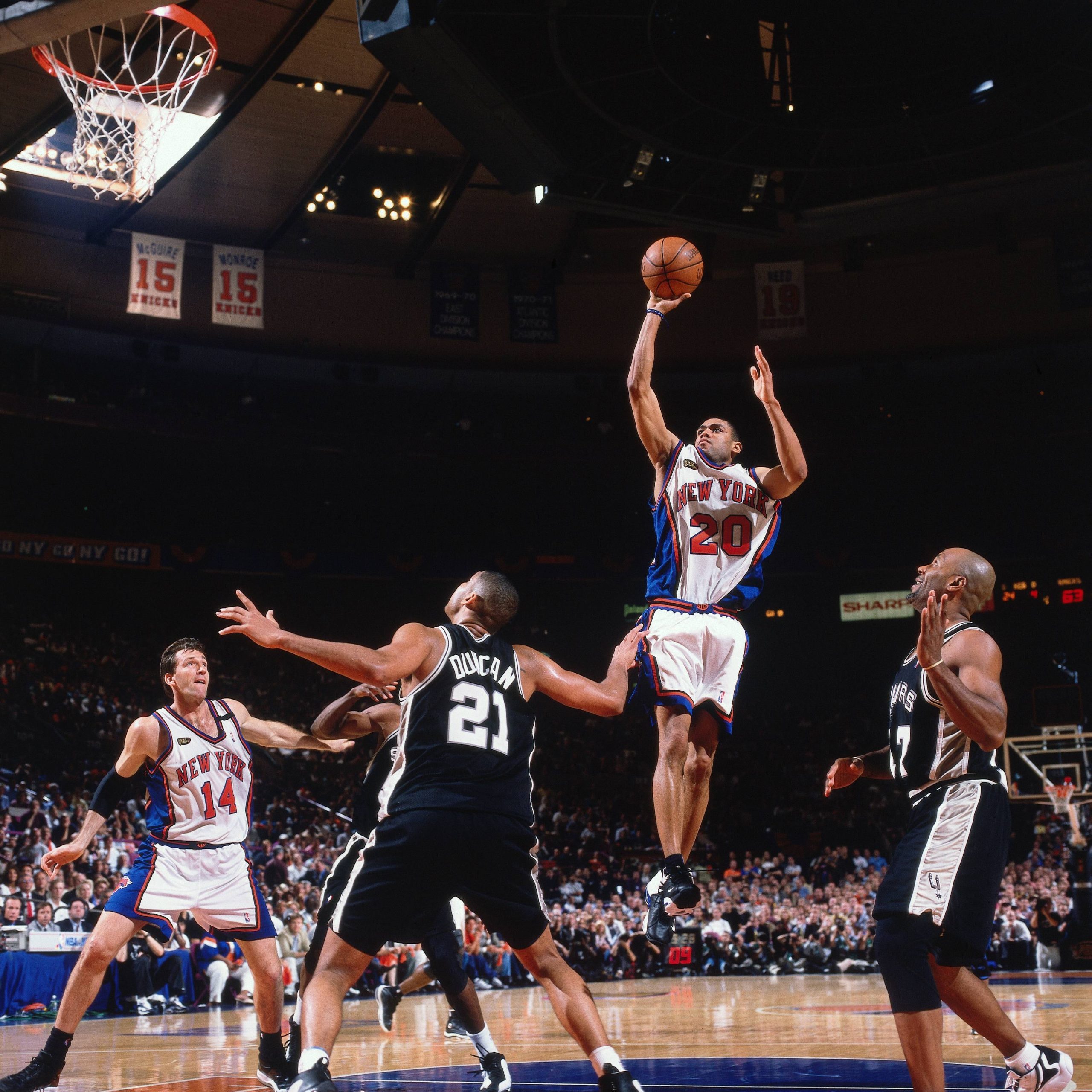
Houston enters the new season equipped with the greatest confidence he’s ever had and, as a newly named tri-captain, a readiness to be the team leader. “I feel like [from] growing up with my dad I notice a lot of things, as far as strategy and advice I can give, that other players don’t. And now that I’ve been here for a while, I feel like I’ve earned certain things and reached the point where I think I’d be hurting the team if I didn’t open my mouth.”
And more important than anything else he’s picked up on the court, in the weight room or in the locker room, Houston has a new perspective that he relishes.
“Now that I’ve had a child and started to prove myself as a player, I’m going to have more fun out there,” he says with a smile. “And if people expect the Knicks to win a championship, that’s fine, too. I, and we as a team, have gone through a lot the last couple of seasons, and that has prepared us for this season.
“It’s not that I didn’t have fun in the past, but I think a lot of people would watch me play, and I’d watch myself play, and they’d say, ‘He’s out there looking like he’s just there to get the job done.’ I don’t want to be perceived that way, because that’s not how I feel out there. I’ve proven things to a certain degree, and now I can relax and play the game like I did in high school. I’m going to go out and accomplish things and have fun doing it.”
And after the game, Allan Houston is going to give and receive love from the people that make him the happiest of all. His parents, his wife and his baby daughter.
Even if she’s crying.