Links: Inside The San Antonio Spurs
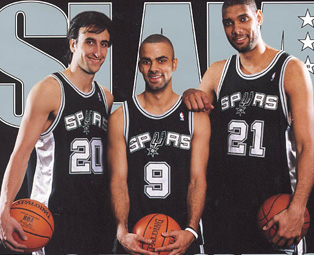
The San Antonio Spurs are SLAM magazine’s nightmare. They’re a great hoops team, but they have little drama, no craziness, nothing to poke fun at. In fact, we spend most of our time here on The Links making fun of Tim Duncan for not doing anything crazy.
The problem becomes, How does SLAM cover the Spurs? We tried making Tim Duncan cool by putting him in a throne made of ice, but he was still boring. For a while there, we just ignored the Spurs. But we couldn’t do that forever, since they kept winning titles.
So back in the spring of 2005, I went to San Antonio for a week to write a cover story about the Spurs. The goal of the story was to try and explain why the Spurs are so good. That’s it. Think about it: They’re probably the best NBA franchise of the last decade, but they operate in such silence that nobody really pays any attention to them. We’d talked about doing some sort of oral history of the team, where it’s just a bunch of quotes assembled into a semi-cohesive narrative. I’d never done a story like that, so all I knew was that I’d need to interview a lot of people. And I did — over the five days I was there, I interviewed every player on the team (except for Rasho Nesterovic, who was never around) and Gregg Popovich. One day at practice I got introduced to RC Buford, the Spurs GM, and he invited me into his office, so I sat with him for about half an hour and got some great stuff.
I spent that week either at games or practices or holed up in my hotel room, transcribing interviews and trying to figure out how it all would fit together. It’s funny, because the only part I actually wrote is the intro, but this story was one of the hardest I’ve ever done, at least in terms of making it fit. Personally, out of all the stuff I’ve done for SLAM, it’s also one of my favorite stories, because it came out pretty well and told a story that, even now, two years later, still explains why the San Antonio Spurs are so damn good.
ROCK SOLID
What do you get when you take a one-horse town, add a humble superstar, a no-bullsh*t coach and a promise to never stop pounding? Just wins, baby.
by Lang Whitaker
“When nothing seems to help, I go look at a stonecutter hammering away at his rock perhaps a hundred times without as much as a crack showing in it. Yet at the hundred and first blow it will split in two, and I know it was not that blow that did it, but all that had gone before.” — Jacob Riis
That quote hangs in the entryway to the San Antonio Spurs locker room, written in English but also translated into Spanish, French and Slovenian. You can’t miss it, even if you can actually understand only one version of it. And that quote might just be the key to the whole thing.
Even though they’re in one of the NBA’s smallest markets, the San Antonio Spurs are always among the League leaders in home attendance — for the 2003-04 season, they sold 97.4 percent of their tickets. “Doesn’t matter who you’re playing, we get a crowd here every night, with people yelling for us and cheering for us,” says their all-world forward, Tim Duncan. Even more impressive, in a League with a salary cap and inverse Draft order designed to strongly encourage parity, the Spurs somehow manage to be really, really good, year after year after year. From the Iceman to the Admiral to Duncan, the Spurs are always right there, waiting, somewhere near the top of the Western Conference. Not to mention winning two of the last six NBA Championships. Health permitting, they should have a great chance at a third next month. The question is, How are the Spurs consistently so good? SLAM went to San Antonio to figure out the secret of their success.
The Philosophy
Brent Barry: It’s so much about the system here. It’s a system-type offense. There’s a lot of teams that have had success with system-type offenses — the Lakers and the Bulls running the triangle offense and kind of plugging players into the system so that the system continues to work. And that’s kind of what San Antonio does.
Gregg Popovich: What’s the system? [whispering] It’s a secret. [laughs] No, every team has a system. Ours isn’t any better than anybody else’s. Every team, every coach has a system, how they manage, how they coach, what the guys do on and off the court. As far as basketball is concerned, our emphasis is defensive rebounding first, and minutes on the court are predicated by that more than anything, more than if you don’t make shots or anything else. That’s a big part of our system, basketball-wise. And then on the offensive end, it’s sharing the ball and ball movement and people movement, but that’s not very different from anybody else. There’s no team that’s going to say, “We try to hold the ball as much as possible,” or, “We’re selfish.” It’s hard to describe I guess.
Tim Duncan: Consistency. That is the system. We just want to do things consistently, methodically, just do them over and over again, just wear people down. That’s defensively, that’s offensively, and that is the system in its basic form.
R.C. Buford, General Manager: Our mantra is, Pound the rock and come to work every day. We don’t want to go from A to D, but we want to go from A to B to C to D. The success is in the simplicity.
Manu Ginobili: Our success is probably because we’ve got such a solid system and such a good coach, a solid coach, who’s always talking about respecting the system and playing as a team, and not all the NBA teams do that. So even while other teams change, we still have a philosophy and a leader.
Robert Horry: The one philosophy that we have here more than any place I’ve been since Houston is that they emphasize defense a whole lot more. Our practices are three-fourths about defense. In L.A. it was all about running the triangle, the ins-and-outs of the triangle and efficiency. That’s a big difference. We focus on D a whole lot more here. In L.A. it was big about not giving up the middle, but everyone pretty much focuses on no middle. There’s a big difference in rotations defensively here.
Popovich: We just don’t want to give up the middle, so we try to force people baseline and bring the weakside help. We concentrate on those kinds of defensive principals that maybe other teams might play it differently.
The Franchise
Buford: The big three in this organization have been Tim, David [Robinson] and Pop, and their consistency, their vision, their compatibility in the issues we talk about. They share a common belief system and structure, and the biggest one is how we play on the floor. There are a lot of teams that would like to build their organizations along the same type of model, but they haven’t been fortunate enough to have Tim, David and Pop. We can say we’ve got it figured out, but we don’t. We were able to figure it out because of those three people.
Ginobili: It’s hard for me to imagine a place that I could feel more comfortable. I’ve found here a great group of people, besides just a winning team. It’s a happy and relaxed environment. That’s always important.
Barry: I think the background work that they do — just making sure that the players that they bring in are of good character, not only can play in the system but are guys they can be proud of on the floor and off the floor — that work is maybe a little in-depth than other teams.
Bruce Bowen: All good organizations have good leaders, and what I mean by that is no-nonsense guys who create an awareness that in order for you to succeed here, you have to do it this way. It’s funny how when guys come here, they can change to conform to what the organization wants, and not, “Oh, this my style, this is how I’ma do it!” Case in point, look at Stephen Jackson. He was great for us. There had been words said about his attitude before he got here, and he fit in with us just right. Now, look at everyone else when they come here, they see the work ethic that a lot of guys exemplify and they understand that in order to be on the same page, they have to get like that.
Buford: That’s the vision Pop started when he came back. When there’s a clarity of statement, a clarity of vision, as far as the people we bring into the program, it’s a much clearer fit.
Tony Massenberg: Everybody gets treated the same way — if you screw up, you’re going to get yelled at, and that means everybody from Tim Duncan to the guys on the injured reserve. That sends a message that it’s all about doing things the right way around here.
Popovich: Tim Duncan allows that to happen. If I can tell Tim at halftime to rebound or that he’s not playing aggressively or whatever it might be and he can accept that coaching, then it’s pretty easy to go to anybody else and tell them that they’re not doing whatever it is the way we described it, and that they should do it the way we described it. You have to point out mistakes and errors to get them corrected, and people have to be able to have the personality to handle that, and these guys do, but it starts with Duncan.
Duncan: Well, that’s just the way I am. That’s what’s been instilled in me from the get-go. I’ve had some great coaches coming up along the way, and I think the biggest thing about that is when you get to the point where someone doesn’t want to yell at you or tell you what you’re doing wrong, you’re the worst for it. So, Pop is equal opportunity with that and we like it that way.
Barry: When you start with Tim Duncan and everybody else falls in line, you’re going to be in good shape.
Popovich: We don’t talk about how many games we’re going to win, winning a division, winning a championship, none of that stuff. No goals, none like that. Our goal is to get better every day, to practice every day, to treat the game with respect, and if we can come out every practice and every game, learning something that we did well or that we did poorly, we can go from there. But I think wins take care of themselves.
Duncan: What Pop’s talking about in that respect is that one takes care of the other. We go out and play better and better every day, and get better, and the results will come. We’ll win the championships, we’ll be in the top teams. That’s his point.
Beno Udrih: We’re just trying to get better every day, but we have some weaknesses and that’s why Pop is here. He’s a great coach and the assistants are great. All the stuff is great.
Ginobili: It’s not only about Duncan and Robinson and Popovich, it’s a whole machine working very sharply and that makes every player here feel comfortable.
Buford: I don’t know if you’ve heard of this book, Good To Great? It was written by a Stanford business professor who took the stock market and found good companies that had sustained 15 years of greatness. And then he took similar-sector companies who had been good but didn’t catch that wave of greatness. He compared the difference between what those companies were. It talks about the “hedgehog concept,” which is basically finding out what you’re passionate about, what you’re best at in the world and then what drives that economic engine, which produces the income that can then sustain that. All of those things, basically, he calls it the hedgehog concept, because…[reading from the book]…”Hedgehogs simplify a complex world into a single organizing idea, a principle concept that unifies and guides everything.” And I think that’s basically what Pop’s deal is.
The Setting
Duncan: We’re kind of, for lack of a better term, a one-horse town, with just the Spurs around here. We have the [WNBA] Silver Starzz now, but that’s a whole different season. So we’re the thing around here. Everyone’s rooting for us and everyone rallies around us. And we love that.
Popovich: We’re a lot like Utah or Portland in that regard, where it’s the only game in town, so to speak. The people fall in love with the Spurs and have always loved the Spurs, and they really love the players as individuals. Like, we just made a trade, sending Malik Rose for Nazr Muhammed, and it was like there was a death in the family. And I think that’s a real tribute to the fans and the players that are here, that the fans feel so close to them. The guys really feel that responsibility, both when they play and when they step off the court and do their community stuff. They know that they’re in a family, and you act differently within your family than you do out on the street.
Tony Parker: I heard about San Antonio because they won a championship in ’99, but I knew nothing about this city, nothing about the staff. I only knew Tim Duncan and David Robinson, that’s it. It’s a great city, because they got only basketball. We have great support here, and the organization is almost like a family. And we’re winning every year, so you know, it’s great.
Buford: I think the city’s supportive of the team because of two things. The culture of the city is one of fiesta — people want to have a good time, and our business people have done a good job in providing that type of atmosphere at the game. But also, we’ve won for 27 years. I think we’re second or third in all-time victories since the franchise came into existence.
Devin Brown: I grew up in San Antonio and was a Spurs fan as a kid, and the Spurs mean everything to San Antonio. People appreciate what we do. And it’s not only because we’re a basketball team, the only professional team here. It has to do with the way we carry ourselves and the way we’ve been winning ball games so long. People appreciate the work we put in. You never really hear about anyone being in trouble or anything, so the people feel proud here. It means a lot.
Ginobili: It’s small, but if you look at numbers it’s not that small — there’s almost a million people. But yeah, it has the spirit of a small town. People are really cool, and they really love the Spurs, so that helps you feel more at home. If you have that, it’s a great society. The franchise is the same. It’s a great group of guys here.
Barry: Surprise, surprise, there are a few nice people left in the world, and most of them are here in San Antonio.
The Players
Parker: When I see how hard Tim plays and the way he handles himself, that makes me want to do the same thing and work hard in practice and bring it every night.
Duncan: Tony came in here with pretty much just his raw skills, and Pop and the coaching staff have done a great job of using that skill and giving him the confidence and the ability to go out there and use those skills — his speed, his ballhandling — to really be effective. But Pop’s probably been on him harder than anyone because he wants him to grow up so fast. He’s probably yelled and screamed at him more than anyone out here. Tony’s been great to take it at such a young age.
Ginobili: My first year was really good, because Tony lived what I was going to live a year before. He knew about how to deal with Pop better, what Pop wanted. He knew me as a player, too, because he saw me play in Europe many times. So it was very nice to have one of the most important parts of the team that knows you and respects you, and knows what you can do.
Duncan: Manu’s come along very similarly to Tony, but with him having played so many years overseas, he matured a lot over there. And as much as he had to adjust to us, we had to adjust to him, with his different style of play, which was something we weren’t used to here. He kind of changed our team and changed it for the better, because he brings that element of, you don’t know what the hell he’s going to do. You can’t plan for him. So when he brings that to a team with the structure that we run, you just can’t plan for that element.
Bowen: You can’t have a bunch of Manu’s on the court at the same time, obviously, but the important thing is that he’s a competitor and that’s just how he’s built, and the way he plays, there’s no one else like that here.
Ginobili: One reason for success here is we have a solid example like Tim, one of the best players in the League. He works as hard as anyone else, is very humble and is always trying to help everybody.
Parker: Tim is consistent, he’s a stud. Every game we know what he’s going to bring. He plays hard every game and he makes his teammates better, too, and that’s the mark of the great players.
Brown: Tim’s a smart basketball player. He’s not going to come out and shout at you when he scores on you. He’s just going to quietly go about his business. He might be playing quietly, but then you look up and he’s got 20 and 16. He’s just gifted, you know?
Bowen: Tim is talented. Sometimes we’re not blessed with the same talents. Michael Jordan was blessed with a lot of talents other people didn’t have. No matter what you do, you may not be able to do what he does. That’s just the way it is — some people have it, some people don’t. You can work to get better, but that doesn’t mean you’ll be able to do what that other person does. You write well. I don’t write well. That’s a talent you have. I’m not going to try and go to school and become an amazing writer. For some people it happens and there’s a passion for it, with others it’s learned and it’s just OK. With Tim, it’s just there.
The Quote
Popovich: You know, I read that quote from Jacob Riis maybe ten years ago someplace. Riis was a reformer back in New York City with all the immigrants, dealing with all the poverty and the lousy situations they all had. He fought City Hall to try to make all that better, and it was a quote from him. I just thought it fit, because all those trite, silly sayings always made me laugh. Like, “Winners always do this” and “Losers always do that” and whatever the hell it is…you know, “There’s no ‘I’ in team.” They’re so old and trite that it’s just silly. But this quote seemed to just make sense. It had an intellectual quality to it, where I thought if the players really looked at it, it’s not just basketball it’s life. You’ve read it so you know what it means. I think that quote is what it’s all about. That persistence in that quote says it all. If there is a system here, that’s the system.
Duncan: He put that quote in there my second year, and that’s our theme, that’s our theme. Keep pounding away at that rock, because you don’t know what’s going to make it change. It might not be every day we’re out here working or it might not be every day we run a play, but at some point it’ll pay off.